Gym website design
Gym Website Design
Mobile-first gym websites that show your space, make memberships easy to compare and put a trial or enquiry within reach on every page.
Professional gym websites from £995, with local SEO foundations built in. Tell us about your gym and you'll get a clear fixed-price quote.

- Professional Gym Websites From £995
- Built Around Membership Enquiries
- Mobile-Friendly Timetables
- Booking Systems Integrated
- Local SEO Foundations
- Custom Functionality Quoted Clearly
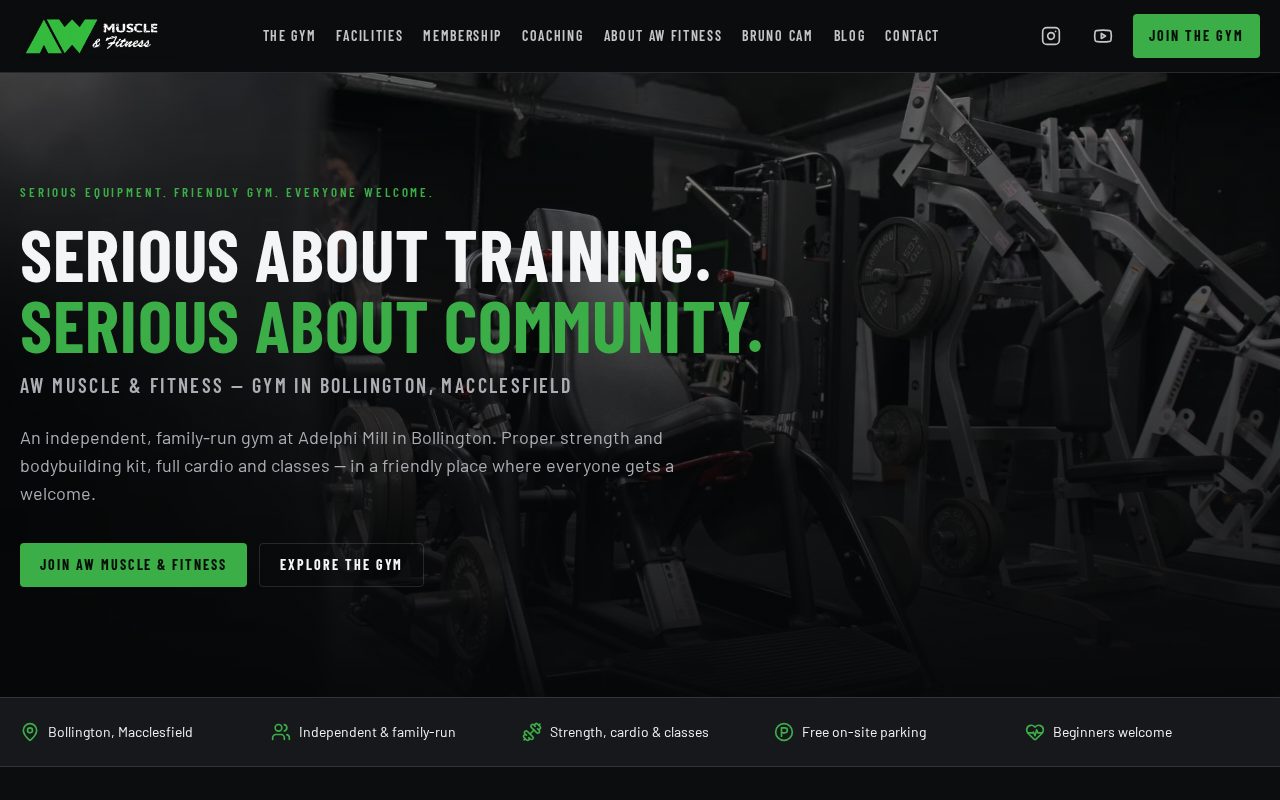
Recent client project
See a gym website we've built
Independent gym · Bollington, Macclesfield
A bold, welcoming website for an independent gym, bringing its facilities, memberships and coaching together in one clear, easy-to-use experience.
- Dedicated pages for facilities and membership options
- Online membership sign-up links through Ashbourne Management
- Personal training and nutrition information
- Blog and contact pages
Professional gym websites from £995
Short answer
How should a gym website help turn visitors into members?
A good gym website should make it easy for potential members to understand what your gym offers, see your facilities and classes, find membership information and take the next step — whether that is booking a trial, making an enquiry or visiting the gym.
Gym Website Design: The Short Answer
A gym website has one job — turn someone who is curious into someone who has booked a trial, a tour or a membership. Gym website features are agreed and priced according to the requirements of the individual project.
It does that by showing the real space, publishing membership options clearly, keeping the timetable accurate, and putting a trial request within reach on every page.
- Real photography of your floor, studio, changing rooms and classes
- Membership options side by side with prices or honest ranges
- A class timetable that works on a phone, not a downloadable PDF
- A free trial, day pass or tour request as the main call to action
- A page for each class people search for by name
- Location, opening hours, parking and access made obvious
What A Gym Website Should Include, Page By Page
Homepage: who you are, where you are and one next step
The first screen should name the type of gym, the town and the main action — usually a free trial or tour. See three gym website homepage examples for strength, coached and multi-location gyms.
Memberships page: prices, inclusions and commitment
List each option with its price or starting point, what it includes, contract length and any joining fee. Our membership pricing page guide covers layouts that are easy to compare on a phone.
Timetable and class pages
One readable timetable, plus a short page for each popular class explaining who it suits, intensity and how to book.
Facilities, team and location
Real photographs of the floor, studios and changing rooms; coach introductions; opening hours, parking and a map.
Trial, tour or day pass page
A focused page with a short form or booking link. See gym trial landing pages.
How People Actually Choose A Gym
Gym decisions are rarely made at a desk. They are made on a phone, in the evening, often on the back of a New Year, a birthday or a doctor's appointment — and almost always with two or three local options being compared at once.
That comparison happens in minutes. Whoever answers the most questions in the fewest taps usually gets the trial booking, and the trial usually gets the membership.
- Distance and parking are decided before anything else
- Price is the next filter, and silence on price loses the visitor
- Atmosphere matters — a strength gym and a boutique studio are different products
- Timetables decide it for anyone with fixed working hours
- Reviews are checked, usually on Google rather than on your site
- A free trial removes the last reason to hesitate

Want to know what your gym's website looks like to a first-time visitor?
Send us your website address and we'll reply with honest, specific feedback on what's stopping people booking a trial. Free, and no sales call.
The Pages Every Gym Website Needs
Each of these pages exists because people search for it, ask about it, or hesitate without it.

Homepage
- What kind of gym you are, in the first sentence
- Where you are and your opening hours
- A trial or tour request within reach
- Photography of the actual space
- Membership prices or a clear link to them
Memberships & Pricing
- Options laid out side by side for comparison
- What each includes — classes, peak hours, guest passes
- Joining fees and contract length stated plainly
- Freeze and cancellation terms
- Student, off-peak, couples and corporate options
Facilities & Equipment
- The free weights area, machines and cardio floor
- Studio spaces and any specialist areas
- Changing rooms, showers and lockers
- Parking and accessibility
- Anything genuinely unusual about your kit
Classes & Timetable
- A readable weekly timetable, updated properly
- A short page for each popular class
- Difficulty level and who the class suits
- Whether booking is required
- Instructor names where they have a following
Free Trial Or Day Pass
This is the page most gym sites are missing, and it is usually the one that converts. Keep the form short and say exactly what happens next.
Personal Training
If trainers work from your gym, give them a page. It sells PT, and it also sells the gym to people who want support rather than a swipe card.
About & Team
Who runs the gym and why it exists. In a market full of chains, being visibly independent and local is an advantage worth writing down.
Contact & Location
- Map, full address and postcode
- Opening hours including bank holidays
- Phone, email and a short enquiry form
- Parking and public transport
- Photos of the entrance so first-timers find it
Turning Visitors Into Members
A gym website converts by removing hesitation, in order. Each step below answers the objection that stops most people at that stage.

Show the room
Real photography of the floor, the studio and the changing rooms. People are deciding whether they would feel comfortable, and only honest photos answer that.
Be straight about price
Publish memberships and joining fees. If prices vary, publish ranges. Ambiguity reads as expensive.
Make the timetable usable
A phone-readable timetable, kept current, tells people they can actually fit training into their week.
Offer a trial
A free trial, day pass or tour turns a decision into an appointment. Put it on every page, not just the homepage.
Prove it with reviews
Genuine member reviews, ideally linked to your Google profile so people can verify them themselves.
Reply fast
Trial requests go cold quickly. Same-day replies convert dramatically better than next-week ones.
Outdated Gym Website vs Modern Gym Website
Most underperforming gym sites are not ugly. They simply make people work for information that should be handed over.

Outdated gym website
- Prices hidden behind "enquire for membership options"
- Timetable as a PDF that will not open on a phone
- Stock photos of a gym that is not yours
- One contact form buried on a contact page
- Classes listed as names with no explanation
- Slow-loading hero video before any useful information
- No trial offer, or one that is impossible to find
- Same page used for multiple locations
Modern gym website
- Membership options and joining fees published clearly
- A readable timetable page, updated as classes change
- Real photography of your floor, studio and team
- Trial and enquiry forms on every page
- A page per popular class, with level and suitability
- Fast mobile loading with the key facts up front
- A free trial or day pass as the primary call to action
- A dedicated page per location with its own map and hours
Getting Found: Local SEO For Gyms
Nearly every gym search is local — "gym near me", "gym in" plus a town, or a class name plus a place. Ranking for those comes down to three things working together.
For questions such as finding a gym with day passes near work, our local AI SEO guide explains which membership, location and visitor details help customers assess your gym.
- A complete Google Business Profile with photos, hours, services and reviews
- A website that names your town and neighbouring areas naturally, not stuffed
- A page for each class and service so you can rank for more than one phrase
- Consistent name, address and phone number everywhere you appear online
- Fast mobile page speed, which affects both rankings and enquiries
- Reviews gathered steadily rather than in one burst
One gym, several towns
If you draw members from surrounding towns, say so in your content — but write genuinely about each area rather than duplicating a page and swapping the place name. Google is very good at spotting the second approach.
Questions Gym Owners Ask Before Commissioning A Website
What pages does a gym website need?
At minimum: a homepage, memberships and prices, a class timetable, facilities, a free trial or tour page, and contact details with opening hours and a map. Those six pages answer most first-visit questions.
Add pages when visitors need distinct information. A gym running boxing, spin and reformer Pilates might give each of those a page covering who it suits, the schedule and how to book. Trainer profiles, a second location or a corporate membership offer are other common additions.
Should a gym website show membership prices?
Usually yes. Show each price, or a clear starting point, together with what that membership includes: off-peak or full access, classes, contract length and any joining fee.
If prices vary by location or promotion, say so and explain how to get the current figure — for example, "Book a tour and we'll confirm today's rate." A visitor who can't find any number often checks a competitor instead.
Can a new website connect to an existing membership system?
Often the simplest route is to link the website to the signup or booking journey your membership provider already runs. An embedded booking flow or a custom integration depends on what that system supports, so we check the provider and scope it before quoting. Read our guide to connecting a gym website to a membership system.
How should a gym show classes and timetables online?
Keep one readable timetable that works on a phone without pinching and zooming, filterable by day or class type where the schedule is large. Link each popular class to its own page where people need to know about suitability, level, equipment or location.
If your booking platform publishes a live timetable, we can usually link to it or embed it where the provider allows, so there is only one schedule to keep up to date.
What helps a gym website generate trial and membership enquiries?
A single, obvious next step — book a free trial, book a tour or join online — repeated on every key page. Real photographs of your floor and studios, clear prices, opening hours and parking information remove the doubts that stop people booking.
A fast mobile site and sound local SEO foundations help people find you in the first place. No website can guarantee a search position; ongoing SEO work such as useful content and a well-maintained Google Business Profile is what builds visibility over time. See what changes the cost of a gym website.
Why Gyms Work With Gee Web Design
Gee Web Design specialises in websites and ongoing SEO for UK health, beauty, fitness and wellness businesses.
You get a site built around trials, memberships and timetables — the things that actually bring members through the door — and you own every part of it.
- Professional gym websites typically start from £995
- Mobile-first build, because that is where gym searches happen
- Membership, facilities and class pages scoped to your requirements
- Links to your existing booking or membership platform; deeper integration depends on the provider and is scoped in the quote
- Local SEO and Google Business Profile foundations from day one
- Typical builds start from around 7–14 days
Related Guides And Next Steps
Health, fitness and wellness website design — the parent guide for the whole sector.
Gym website cost — what a gym website costs and what changes the price.
See the essential features a gym website should include.
Best Gym Management Software UK — eight platforms to compare before choosing.
Gym website redesign — when to redesign and how to protect your existing SEO.
Gym website not generating enquiries — practical fixes for forms, membership information and follow-up.
Gym trial landing pages — plan a focused page for tours, trials and day passes.
Gym SEO costs — compare the £195 and £295 monthly SEO packages and what they cover.
Gym website audit checklist — review mobile layout, prices, forms, joining links and SEO.
How to choose a gym website designer — what to ask about scope, costs, ownership and SEO.
Gym membership pricing page design — make plans, commitments and joining options easy to understand.
ClubRight website integration — build your website around supported ClubRight joining and booking tools.
GymMaster website integration — plan supported joining, timetable and member-portal connections.
Gym website homepage examples — three illustrative layouts for strength, coached and multi-location gyms.
Gym website maintenance and support — keeping prices, hours, forms and joining links accurate after launch.
DIY vs professional gym website — comparing the time, costs and responsibilities of each route.
Gym websites in Peterborough — our home city, with local access, membership and SEO considerations.
Gym websites for Cambridge — first-visit, membership and search planning for gyms we serve in Cambridge.
Gym websites for Leicester — separating membership, classes and coaching for gyms we serve in Leicester.
Gym websites for Nottingham — class timetables, memberships and booking journeys for gyms we serve in Nottingham.
Gym websites for Manchester — facility-led pages and clear membership paths for specialist gyms we serve in Manchester.
Gym websites for Birmingham — clear prices, facilities and joining routes for gyms we serve in Birmingham.
Gym websites for Leeds — facility details, memberships and coaching journeys for gyms we serve in Leeds.
Gym websites for Bristol — real facilities, clear memberships and enquiry routes for gyms we serve in Bristol.
Gym websites for Sheffield — focused improvements and scoped redesigns for gyms we serve in Sheffield.
Gym websites for London — clear location details and joining journeys for single or multi-location gyms we serve in London.
Multi-location gym website design — clear journeys and accurate pages for every facility.
Ashbourne website integration — an independent guide to joining links, pricing and testing.
Google Business Profile for gyms — ownership, verification, hours, photos, reviews and links.
Why your gym is not showing on Google — diagnose indexing, Business Profile and redesign problems.
25 Gym Marketing Ideas — practical ways to attract and keep members.
How to Get More Gym Members — offers, follow-up and retention for UK gyms.
SEO for Gyms — how to help more local people find and choose your gym.
Personal trainer website design — for trainers working from your gym or their own studio.
Nutritionist website design — for nutrition professionals and gym partnerships.
View our website packages and pricing.
Explore our local SEO services to be found across your catchment.
FAQ
Gym Website Design FAQs
Keep reading
Explore our other guides and hubs
Every guide we publish, one click away — pick the trade or topic closest to your business.
Website Design by Industry
The full directory of industry-specific website design services we offer across the UK.
Trades Website Design: The Complete Guide
The pillar guide to website design for UK trades — every trade we build for, plus SEO, AEO, galleries and local search.
Plumber Website Design: The Complete Guide
How plumbing companies build websites that win emergency call-outs and booked jobs.
Locksmith Website Design That Generates Calls
Websites for locksmiths built around emergency lockouts, local search and one-tap calling.
Electrician Website Design That Generates Enquiries
Websites for electrical contractors that lead with accreditations and convert enquiries.
Pest Control Website Design That Wins Jobs
Websites for pest control companies with treatment pages by pest type and same-day availability.
Builder Website Design That Wins Projects
Websites for builders and construction companies built around project galleries and quote forms.
Painter and Decorator Website Design That Sells Your Finish
Websites for painters and decorators built around before-and-after galleries and quote forms.
Joiner Website Design Built Around Your Craftsmanship
Websites for joiners, kitchen fitters and joinery companies built around project galleries.
Carpenter Website Design That Fills Your Diary
Websites for carpenters covering first fix, second fix, roofs, decking, flooring and kitchen fitting.
Roofing Website Design That Books Surveys
Websites for roofing companies covering emergency call-outs, flat and pitched roofs, repairs, re-roofs and guttering.
Plasterer Website Design That Fills Your Diary
Websites for plasterers covering skimming, external rendering, silicone render, dry lining, ceilings and coving.
Landscaping & Driveway Website Design
Websites for landscapers and driveway installers covering block paving, resin, tarmac, patios, artificial grass, fencing and decking.
Kitchen Fitter Website Design
Websites for kitchen fitters and kitchen companies covering bespoke, luxury, budget and flat-pack kitchens, renovations, worktops and appliances.
Bathroom Fitter Website Design
Websites for bathroom fitters and bathroom companies covering full refurbishments, wet rooms, en suites, accessible bathrooms, tiling and plumbing.
Flooring Website Design
Websites for flooring companies and floor fitters covering wood, laminate, LVT, vinyl, carpet, commercial flooring and floor restoration.
Scaffolding Website Design
Websites for scaffolding companies covering domestic, commercial and industrial scaffolds, temporary roofs, access towers, CISRS competence and site survey enquiries.
Window & Door Installer Website Design
Websites for window and door installers and double glazing companies covering uPVC, aluminium, composite doors, bi-folds, sliding doors, conservatories and FENSA trust signals.
Heating Engineer Website Design
Websites for heating engineers and boiler companies covering boiler installation, servicing, repairs, heat pumps, underfloor heating, smart controls and commercial heating.
Drainage Website Design
Websites for drainage companies covering drain unblocking, CCTV surveys, jetting, root removal, drain repairs, emergency call-outs and commercial drainage.
Cleaning Company Website Design
Websites for cleaning companies covering domestic cleaning, deep cleans, end of tenancy, office and commercial contracts, carpets, ovens and specialist cleaning.
Health, Fitness & Wellness Website Design
The parent guide for gyms, nutritionists, personal trainers and the wider UK wellness sector.
Nutritionist Website Design
Websites for nutrition professionals built around credibility, consultation booking and educational content.
Personal Trainer Website Design
Websites for personal trainers and coaches built around personal brand, packages and online coaching.
Gym Website Cost: What You Should Expect to Pay
Honest gym website pricing and what memberships, timetables and integrations add.
What a Gym Website Should Include
Memberships, timetables, facilities and trials — and how to decide what you need.
Nutritionist Website Cost Explained
What a nutrition website costs, and whether to redesign or rebuild.
SEO for Nutritionists
A plain-English guide to being found by people searching for nutrition help.
Personal Trainer Website Cost Explained
What a PT website costs, and when custom booking is worth paying for.
SEO for Personal Trainers
Location relevance, service pages, reviews and a simple checklist.
Get a free review of your gym website
Send us your current site, or just your membership options and location, and we'll reply within 24 hours with honest feedback on what's costing you trials. No charge and no pressure.
Ready For A Gym Website That Fills Trials?
Tell us about your gym, your membership options and the area you draw from, and we'll suggest the shortest route to more trial bookings and more members.