Small business marketing
How to Promote Your Business for Free: 30 Ways to Get More Customers in 2026
You do not need a huge advertising budget to get more customers. Many of the most useful marketing activities available to a small business cost nothing apart from time. The problem is knowing where to start.
Posting randomly on social media, printing flyers and hoping somebody sees them is not a marketing strategy. A better approach is to concentrate on the places your potential customers already search, ask questions, compare businesses, read reviews, spend time and ask for recommendations.
This guide gives you 30 practical ways to promote your business without paying for advertising. For every idea you get what it is, who it works best for, how difficult it is, what it costs, roughly how long the first action takes, exactly what to do, and how to tell whether it is working.
Read this bit first
You do not need to complete all 30. Pick three or four that match how your customers actually find businesses like yours and do them consistently.

What is the best way to promote a small business for free?
For many small businesses, the strongest free marketing combination is a complete Google Business Profile, genuine customer reviews, a useful website, local SEO, helpful content, referrals and consistent activity on the one or two social platforms their customers actually use. The best strategy depends on what you sell, where your customers are and how they normally choose a supplier.
If you only have one hour today
- 1Check your Google Business Profile.
- 2Ask two happy customers for reviews.
- 3Check whether your website clearly explains what you do.
- 4Make sure Google can find your website.
- 5Follow up one old enquiry.
- 6Publish one useful piece of content answering a customer question.
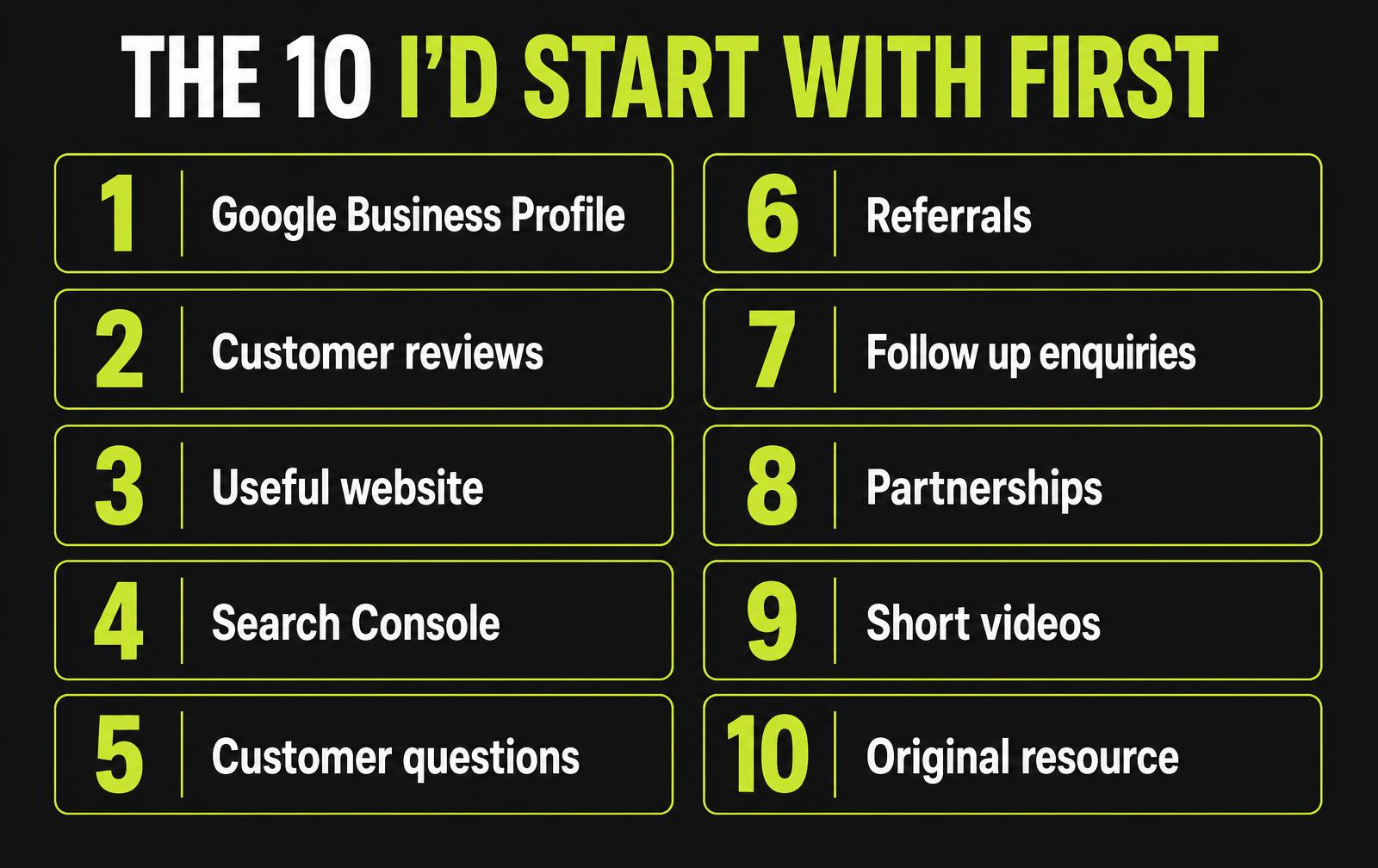
The 10 free marketing ideas I'd start with first
All 30 ideas below are useful to somebody. These ten are the ones most UK small businesses get the fastest value from. Treat it as a practical starting point — not a universal ranking.
| Priority | Method | Best for |
|---|---|---|
| 1 | Google Business Profile | Local businesses |
| 2 | Customer reviews | Almost every business |
| 3 | A useful website | Almost every business |
| 4 | Search Console | Website owners |
| 5 | Customer questions as content | Most businesses |
| 6 | Referrals | Service businesses |
| 7 | Following up old enquiries | Businesses with leads |
| 8 | Partnerships | Local and B2B services |
| 9 | Short helpful videos | Visual and expert businesses |
| 10 | An original useful resource | Businesses building authority |
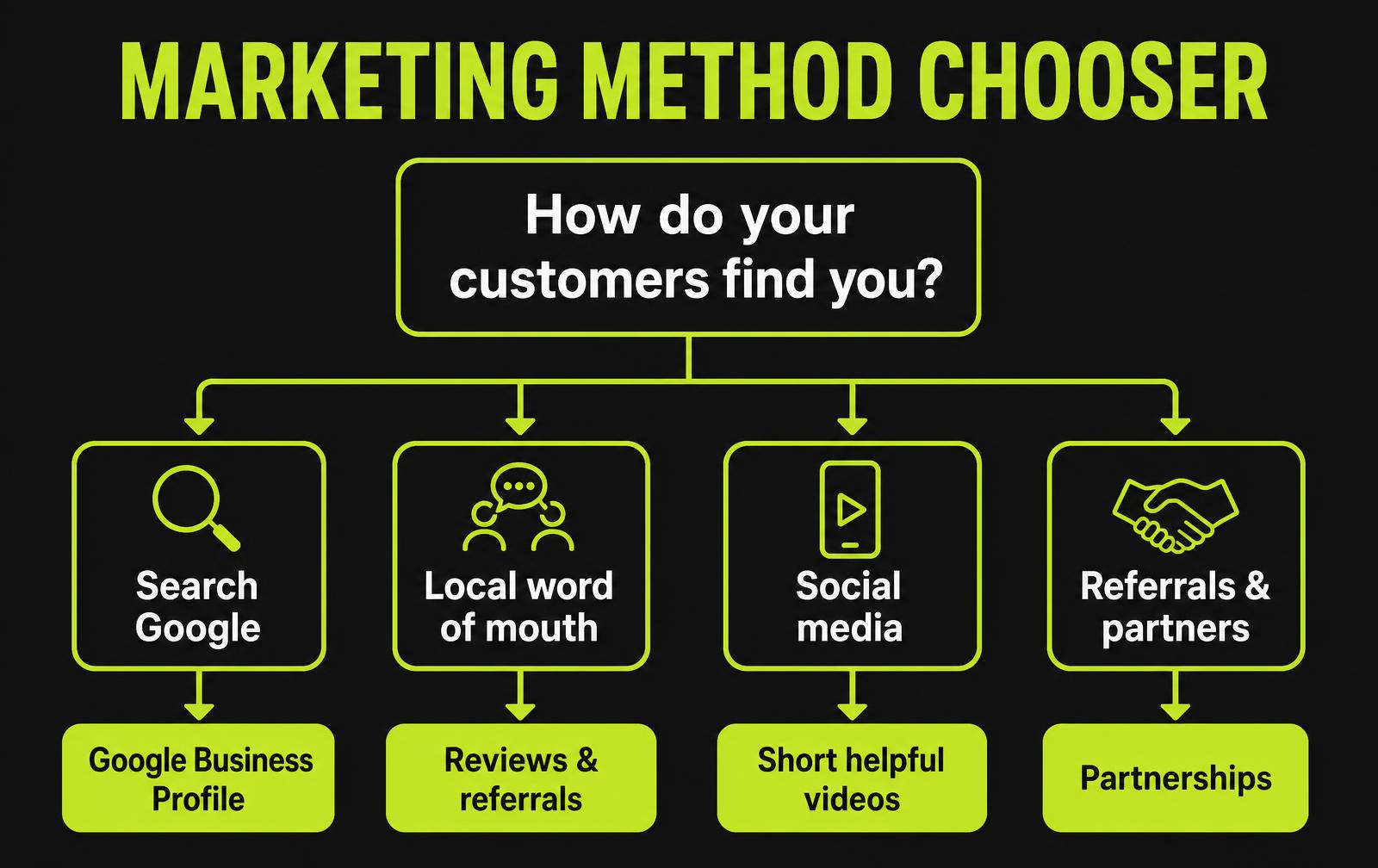
Marketing method chooser: where should you start?
Find the statement that sounds most like your business. That tells you which of the 30 ideas below to read first.
“My customers search Google when they need my service”
Start with Google Business Profile, reviews, service pages and Search Console.
Ideas 1-8
“My customers ask friends and neighbours for recommendations”
Start with reviews, referrals, local groups and community involvement.
Ideas 2, 12, 13, 27
“My work is visual and people judge it by seeing it”
Start with before-and-after posts, short videos and case studies.
Ideas 22, 23, 24
“My customers come through other businesses”
Start with partnerships, supplier listings and referral relationships.
Ideas 14, 19, 20
“I already get enquiries but not enough of them turn into work”
Start with your homepage, service pages, follow-ups and re-engagement.
Ideas 7, 8, 26, 28
“I want to build long-term authority in my industry”
Start with helpful content, email and one genuinely original resource.
Ideas 10, 25, 29, 30
Part one
Get found on Google
1. Set up or improve your Google Business Profile
- Cost
- Free
- Difficulty
- Beginner
- First action
- 20 minutes
- Best for
- Any business with local customers
Google Business Profile is the free tool that lets eligible businesses manage how their business information can appear across Google Search and Google Maps — the name, category, opening hours, phone number, website, services, photos and reviews people see before they ever reach your website.
Not every business qualifies. Google's current eligibility guidelines say a business must make in-person contact with customers during its stated hours — so you either need somewhere customers visit, or you travel to them, in which case you set yourself up as a service-area business rather than a storefront.
For a local business this is often the single most valuable free asset you own. Someone searching for a plumber in Nottingham or a nutritionist in Cardiff frequently makes a shortlist from those local results without visiting a single website first. An incomplete or out-of-date profile quietly removes you from that shortlist.
Do this now
- 1Search Google for your exact business name.
- 2Check whether a Business Profile already exists.
- 3If you manage it, review every field.
- 4Confirm the business name is accurate.
- 5Check the primary category is the one customers would choose.
- 6Check your opening hours, including bank holidays.
- 7Check the telephone number.
- 8Check the website address.
- 9Add the relevant services you actually offer.
- 10Add genuine photographs of your work, team or premises.
- 11Check your service area or address setup is correct.
- 12Remove anything outdated.
Do not do this
Do not stuff keywords into your business name unless they are genuinely part of the real-world business name. Google's own guidelines require the name to be the one your business actually uses, and profiles that break this can be suspended.
Every field, and what to put in it, is covered step by step in our Google Business Profile optimisation guide. Eligibility and naming rules are set by Google, so check their current Business Profile guidelines before making changes.
2. Ask happy customers for Google reviews
- Cost
- Free
- Difficulty
- Beginner
- First action
- 15 minutes
- Best for
- Almost every business
Reviews help future customers evaluate your business when they have never met you. They answer the question every buyer is silently asking: did this go well for somebody like me? A handful of recent, specific, genuine reviews often does more for a small business than a much larger number of vague ones.
Nobody can honestly promise you that reviews will move you up the rankings by a specific amount. What they reliably do is give a real person a reason to choose you over the identical-looking business next to you.
Do this now
- 1Identify your five happiest recent customers.
- 2Find your Google review link in your Business Profile.
- 3Send a polite, individual request — not a mass mailout.
- 4Make the process as easy as possible: one link, one tap.
- 5Do not tell customers what rating to leave.
- 6Respond professionally to every review, including the difficult ones.
An example message you can copy
“Thanks again for choosing us. If you're happy with the work, would you mind leaving us a quick Google review? It really helps a small business like ours. Here's the link: [review link]”
Never do any of this
Never buy reviews, create fake reviews, review-gate (only asking customers you believe will be positive), or pressure customers into leaving one. Google is explicit that offering incentives such as free or discounted goods in exchange for posting, changing or removing reviews counts as fake engagement and is prohibited.
3. Make sure Google can find your website
- Cost
- Free
- Difficulty
- Beginner
- First action
- 15 minutes
- Best for
- Anyone with a website
Having a website does not automatically mean every important page is indexed by Google. Indexed means Google has crawled the page, understood it, and stored it so it can be shown in search results. A page that is not indexed cannot appear, no matter how good it is.
This is one of the most common and most invisible problems we find on small-business websites: a perfectly good service page that Google has simply never included.
Do this now
- 1Search Google for your business name and see what comes back.
- 2Try a quick site:yourdomain.co.uk search as a rough indication of what is included.
- 3Use Google Search Console for the definitive page-level check.
- 4Inspect your homepage URL.
- 5Inspect your most important service pages.
- 6Check your sitemap has been submitted and read successfully.
- 7Investigate any page that should be visible but is not indexed.
If pages are missing, work through the causes one at a time and find out why your website isn't showing on Google.
4. Start using Google Search Console
- Cost
- Free
- Difficulty
- Beginner
- First action
- 30 minutes to set up
- Best for
- Anyone with a website
Search Console shows how your website is performing in Google Search before visitors reach your website. It is the only place you can see the actual searches people typed when your pages appeared.
The five words worth learning: queries (what people searched), impressions (how often you appeared), clicks (how often they chose you), pages (which page appeared) and indexing (whether Google has included the page at all).
Do this now
- 1Open Search Console and verify your website.
- 2Choose your website property.
- 3Open the Performance report for Search results.
- 4Look at the Queries tab.
- 5Find searches that are genuinely relevant to what you sell.
- 6Find important pages getting impressions but very few clicks.
- 7Write down one content opportunity you can act on this month.
If you have never opened it before, our Google Search Console for beginners guide walks through setup and every report in plain English.
5. Install and actually use Google Analytics
- Cost
- Free
- Difficulty
- Beginner
- First action
- 30 minutes to set up
- Best for
- Anyone with a website
Search Console tells you what happens in Google. Analytics is useful for understanding what happens after visitors arrive: how many people came, where they came from, which page they landed on, whether they engaged, and whether they completed anything that matters to you.
Most small businesses need five things from it — traffic, source, landing pages, engagement and important actions. You can safely ignore the rest until you need it.
Do this now
- 1Check that GA4 is installed and actually collecting data.
- 2Open Traffic acquisition to see where visitors come from.
- 3Open the Landing pages report to see where they arrive.
- 4Identify which pages receive the most visitors.
- 5Check whether meaningful actions — enquiries, calls, form submissions — are being tracked at all.
Every one of those steps is explained from zero in our Google Analytics for beginners guide, including a plain-English UK privacy section.
6. Find the searches your customers actually use
- Cost
- Free
- Difficulty
- Beginner
- First action
- 30 minutes
- Best for
- Any business with a website
A business owner often describes their service completely differently from the customer buying it. That gap is expensive, because you end up optimising for words nobody types.
Business wording
Domestic heating solutions
Customer wording
boiler repair near me
Do this now
- 1Write down the exact questions customers ask you on the phone.
- 2Type your main service into Google and read the suggestions.
- 3Check the Queries report in Search Console for real searches you already appear for.
- 4Compare a couple of wordings in Google Trends.
- 5Read back through your last twenty enquiries and note the language they used.
Do not keyword-stuff
Using the customer's wording naturally in your headings and copy is good practice. Repeating a phrase twenty times is not, and reads badly to the human you are trying to win.
Our guide to keyword research for small businesses shows how to turn that list into pages.
7. Improve the first 10 seconds of your homepage
- Cost
- Free
- Difficulty
- Beginner
- First action
- 20 minutes
- Best for
- Any business with a website
A visitor should be able to work out four things almost immediately: what you do, who you help, where you work and what to do next. If any of those take effort, most people leave and try the next result.
Weak
Welcome to Smith Solutions
Better
Emergency Plumbing & Boiler Repairs Across Leeds
Do this now
- 1Open your homepage on a phone.
- 2Mentally hide the logo.
- 3Read only the main heading and the first paragraph.
- 4Ask: would a stranger immediately know what this company sells?
- 5Check there is one obvious next step — call, enquire, book.
Quick win
Change a vague homepage heading into a clear service-led statement that names what you do and where you do it. It takes ten minutes and it is often the highest-value free change on this entire list.
8. Create a proper page for each main service
- Cost
- Free
- Difficulty
- Intermediate
- First action
- 1 hour per page
- Best for
- Businesses with several distinct services
One generic “Services” page listing eight things in bullet points makes life harder for both customers and search engines. Nobody searches for “services”. They search for the specific thing they need, and they want a page that clearly answers it.
Plumber
Boiler installation · Boiler servicing · Emergency plumbing · Bathroom plumbing
Accountant
Self Assessment · Payroll · Limited company accounts · VAT
Do this now
- 1List your five most important services.
- 2Search your own website for each one.
- 3Ask whether each service has enough information for someone to buy.
- 4Create a useful dedicated page where that is justified.
- 5Explain price, process, timescale and common questions where you can.
- 6Link related pages to each other so people can move between them.
Our guide on how to write service pages that rank and convert covers the structure we use on client sites.
9. Create useful content for the areas you actually serve
- Cost
- Free
- Difficulty
- Intermediate
- First action
- 1 hour per page
- Best for
- Local and regional service businesses
A location page explains what you do in a specific place, for people searching in that place. Done properly they are genuinely useful. Done lazily they are the most common self-inflicted SEO problem in small-business marketing.
The mistake to avoid
Do not create 100 copied pages and replace the town name on each one. A useful location page contains genuine local relevance: real coverage, real examples, real detail about working in that area.
Do this now
- 1Write down where your customers actually come from.
- 2Identify the most valuable genuine service areas.
- 3Check whether your website explains that coverage anywhere.
- 4Create location pages only where you can add meaningful information.
- 5Link them sensibly from your service and location structure.
You can see how we structure ours across our web design services across the UK, and the local SEO checklist for UK businesses covers the supporting work.
10. Answer customer questions on your blog
- Cost
- Free
- Difficulty
- Beginner
- First action
- 1 hour
- Best for
- Any business asked the same questions repeatedly
The easiest article ideas often come from real questions customers ask before buying. You do not need to invent topics. You need to write down what people already ask you.
- How much does it cost?
- How long does it take?
- Which option should I choose?
- Do I really need it?
- Can I do it myself?
- What happens next?
Do this now
- 1Open the notes app on your phone.
- 2Write down ten questions customers actually ask.
- 3Choose the most useful one.
- 4Search it and read what currently ranks.
- 5Work out what information is missing, vague or out of date.
- 6Create a better answer based on your real experience.
If you get stuck for topics, here are blog post ideas that can increase website traffic.
Part two
Become more visible locally
11. Get listed in useful business directories
- Cost
- Free
- Difficulty
- Beginner
- First action
- 30 minutes
- Best for
- Trades, regulated professions and local services
A small number of respected directories can send genuine enquiries and confirm that your business is real. Useful ones tend to include respected industry directories, trade bodies, genuine local directories, recognised business platforms and supplier or dealer listings.
Not this
Do not submit your business to hundreds of low-quality directories. It rarely produces customers, it creates inconsistent business details across the web, and maintaining it wastes time you could spend on the first ten ideas in this guide.
Do this now
- 1Search for “[your industry] directory UK”.
- 2Search for “[your location] business directory”.
- 3Ask of each one: is it genuine, and do customers actually use it?
- 4Check it is relevant to what you sell and contains real businesses.
- 5Decide whether the listing is worth keeping up to date.
- 6Keep your business name, address and phone number identical everywhere.
12. Use local Facebook groups without spamming them
- Cost
- Free
- Difficulty
- Beginner
- First action
- 20 minutes
- Best for
- Local consumer services
Local community groups are where a lot of UK recommendation requests happen: “can anyone recommend a decent electrician?” appears in these groups constantly. Being the person who already helps in that group is worth far more than being the person who joined this morning to post a link.
Do not do this
Do not join twenty groups and post “Hi everyone, I run XYZ — call me!”. Instead answer relevant questions, recommend useful solutions, take part, share work only when the group rules allow it, and become recognisable.
Do this now
- 1Search Facebook for genuine community groups in your service areas.
- 2Join two or three relevant groups — not twenty.
- 3Read the rules before posting anything.
- 4Search the group for questions related to what you do.
- 5Help before you sell.
Always
Follow each individual group's rules on business posts and self-promotion.
13. Get involved in local community groups
- Cost
- Free
- Difficulty
- Beginner
- First action
- 1 hour
- Best for
- Established local businesses
Community associations, business groups, sports clubs, charities, events, local online groups and neighbourhood organisations all put you in front of people who live and buy locally. Relationships built this way can create referrals, awareness, partnerships, press opportunities and genuine mentions of your business.
Keep it honest
Do not sponsor something you do not care about purely to obtain a backlink. It is transparent, it rarely works, and the relationship is worth more than the link.
14. Partner with businesses that serve the same customers
- Cost
- Free
- Difficulty
- Beginner
- First action
- 20 minutes
- Best for
- Service businesses of any size
Somebody else is already talking to your future customer about something related. Those businesses are the cheapest source of qualified work you will ever find.
- Wedding photographer + florist
- Builder + architect
- Plumber + bathroom fitter
- Personal trainer + nutrition professional
- Web designer + photographer
- Accountant + business consultant
Do this now
- 1Write down five businesses serving similar customers without directly competing.
- 2Contact one of them.
- 3Propose something genuinely useful rather than asking for favours.
- 4Refer genuinely suitable customers both ways.
- 5Consider creating joint educational content.
15. Give local newspapers and websites a real story
- Cost
- Free
- Difficulty
- Intermediate
- First action
- 45 minutes
- Best for
- Businesses with something genuinely newsworthy
“Company exists” is not usually a strong story. Editors need a reason for their readers to care. Stronger angles include unusual research, a charity initiative, local employment, a significant milestone, a community project, an unusual customer story shared with permission, useful industry data or a genuine local trend.
A simple pitch structure
Subject: New data reveals [useful local or industry finding]
Then, in four short paragraphs: what happened, why readers should care, your evidence, and your contact details.
Our own example of this is our analysis of 500 UK plumbing websites — data that did not exist anywhere else, which gives a journalist something to write about.
16. Enter genuine, relevant business awards
- Cost
- Free to enter (the good ones)
- Difficulty
- Intermediate
- First action
- 1 hour
- Best for
- Established businesses with a story to tell
A relevant award can bring credibility, exposure, networking and local coverage — and the entry process itself often forces you to articulate what makes your business different, which is useful on its own.
Be selective
Avoid vanity “awards” that simply ask businesses to pay for meaningless recognition. If the main requirement is a fee and a logo licence, it is advertising, not an award.
17. Attend local networking events
- Cost
- Free to low cost
- Difficulty
- Beginner
- First action
- One morning
- Best for
- B2B and local service businesses
Networking is far more effective when the objective is relationships rather than handing out the most business cards. The people in the room are not your customers; some of them know your customers.
Before you attend
Prepare one sentence: “I help [type of customer] with [problem].” That is more memorable than a 60-second corporate speech.
After the event
Follow up the two or three useful conversations within a few days, while they remember you.
18. Create a simple referral programme
- Cost
- Free to set up
- Difficulty
- Beginner
- First action
- 30 minutes
- Best for
- Service businesses with repeat customers
People already happy with your business are an overlooked source of new customers. A referral programme just means making it obvious that you welcome recommendations, and thanking people properly when they make one.
Possible rewards include account credit, a discount, a small gift, a charitable donation or a reciprocal referral.
Two important boundaries
Only use incentives where they are lawful and appropriate for your industry — regulated professions may have specific rules. And never incentivise positive reviews. Keep referral rewards and review requests completely separate.
19. Ask suppliers or manufacturers to feature your business
- Cost
- Free
- Difficulty
- Beginner
- First action
- 30 minutes
- Best for
- Trades, installers and retailers
The companies whose products you fit, stock or use often maintain approved installer directories, retailer or stockist directories, case studies, partner spotlights and installer finders. Those listings are usually free to accredited businesses, and the people using them are ready to buy.
Do this now
- 1List the manufacturers, suppliers, software providers and trade organisations you already work with.
- 2Look at their websites for “Find an installer”, “Partners”, “Stockists”, “Case studies” or “Approved contractors”.
- 3Check the requirements for being listed.
- 4Apply, and offer to take part in a case study.
- 5Check your existing listings are accurate and still live.
20. Build partnerships instead of constantly chasing cold leads
- Cost
- Free
- Difficulty
- Intermediate
- First action
- 30 minutes
- Best for
- Any service business
There is a large difference between winning one lead and building one relationship capable of producing leads for years. An estate agent who trusts a cleaner, a kitchen showroom that trusts a fitter, or a nutritionist who trusts a personal trainer will refer work repeatedly without you spending anything.
Your partnership map
My customer: ______
What else do they buy before or after my service? ______
Which businesses sell that? ______
Part three
Content and social media
21. Turn customer questions into social media posts
- Cost
- Free
- Difficulty
- Beginner
- First action
- 15 minutes
- Best for
- Any business active on social media
Stop asking “what should I post?”. Use the questions customers actually ask you. They are proof of what your audience wants to know, and you already know the answer.
One question — “how long does a website take to build?” — becomes an Instagram post, a Reel, a Facebook post, a LinkedIn post, a website FAQ and a blog article.
Do this now
- 1Choose one question you were asked this week.
- 2Answer it publicly, in your own words, today.
22. Film short helpful videos
- Cost
- Free
- Difficulty
- Beginner
- First action
- 10 minutes
- Best for
- Expert and hands-on businesses
You do not need professional cameras. A phone, decent light and something genuinely useful to say is enough. People buy from people, and 45 seconds of you explaining something clearly does more than a stock photo ever will.
- Plumber: why boiler pressure drops
- Painter: why paint peels
- Personal trainer: three beginner squat mistakes
- Accountant: what you need before your tax return
- Web designer: three things making your homepage harder to use
A simple video structure
Hook → explanation → example → next step. Keep authenticity over polished corporate production.
23. Publish before-and-after work
- Cost
- Free
- Difficulty
- Beginner
- First action
- 15 minutes
- Best for
- Visually demonstrable services
Building, painting, landscaping, kitchens, websites, hair and beauty, restoration and fitness work — where appropriate and with valid consent — all benefit enormously from showing the change rather than describing it.
Do this now
- 1Before.
- 2The problem the customer had.
- 3What you changed.
- 4After.
- 5The outcome.
- 6How to enquire.
Two rules
Do not fabricate outcomes, and obtain permission before publishing anyone's property, premises or personal results.
24. Turn customer work into case studies
- Cost
- Free
- Difficulty
- Intermediate
- First action
- 45 minutes
- Best for
- Businesses selling considered purchases
A case study is far more useful than “another happy customer!”, because it lets the next buyer recognise themselves in it. Structure it simply: the problem, what the customer needed, what you did, why you did it, the result, and what another customer can learn from it.
Honesty rule
If there are no measurable results, do not invent them. “The owner can now update their own opening hours” is a real outcome. A made-up percentage is not.
You can see how we present real work on our case studies page.
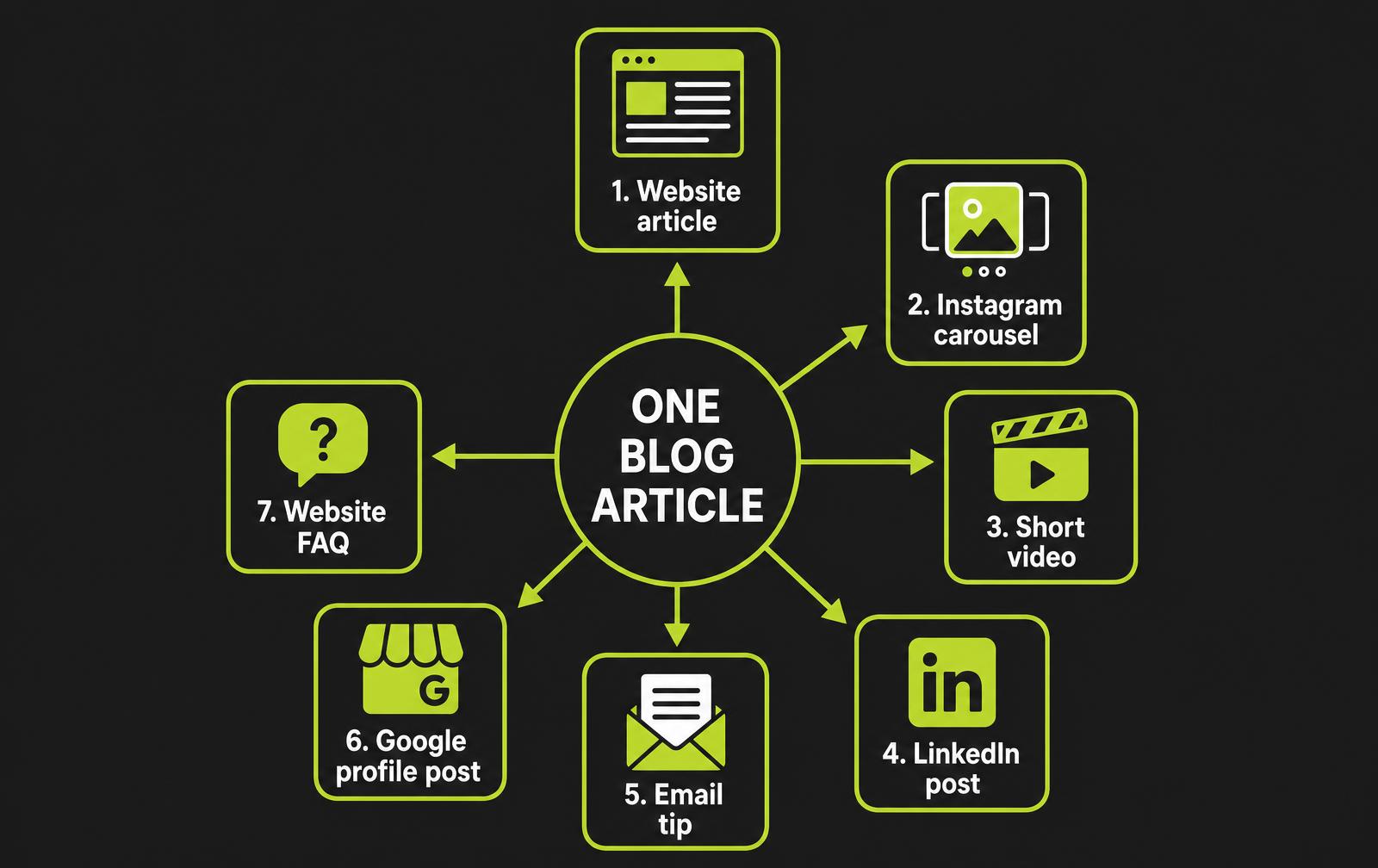
25. Turn one good piece of content into five
- Cost
- Free
- Difficulty
- Beginner
- First action
- 30 minutes
- Best for
- Anyone short of time
Take one article — say “How much does a small business website cost?” — and it becomes a website article, an Instagram carousel, a short video, a LinkedIn post, an email tip, a Google Business Profile post where appropriate, and an FAQ answer on your site.
The point
You do not need seven new ideas every week. You may need one good idea used seven ways.
Part four
Get more from people who already know you
26. Follow up old enquiries
- Cost
- Free
- Difficulty
- Beginner
- First action
- 20 minutes
- Best for
- Any business that receives enquiries
Businesses spend time and money generating enquiries, then often forget everyone who did not buy immediately. Plenty of those people did not choose a competitor — they got busy, the timing was wrong, or they simply forgot. This is the highest-return twenty minutes on the entire list.
Do this now
- 1Look at enquiries from last week, last month and last quarter.
- 2Identify people who asked for information but never replied.
- 3Identify people who requested a quote and went quiet.
- 4Identify anyone who said “later”.
- 5Send one short, low-pressure message each.
Wording you can use
“Hi [Name], just checking in following our conversation about [service]. I wasn't sure whether you'd sorted it yet, so wanted to see whether you needed any further information from me. No problem if your plans have changed.”
Keep it exactly that relaxed. Nothing aggressive, no false deadlines.
27. Ask existing customers for referrals
- Cost
- Free
- Difficulty
- Beginner
- First action
- 10 minutes
- Best for
- Service businesses
A review is public feedback for strangers. A referral is a private recommendation to someone the customer knows. They are different things and it is worth asking for both — separately.
Natural wording
“I'm glad you're happy with everything. Most of our work comes through recommendations, so if you know anyone else who needs [service], we'd really appreciate you passing our details on.”
Ask once, warmly, and leave it there. Do not pressure customers.
28. Re-engage previous customers
- Cost
- Free
- Difficulty
- Beginner
- First action
- 30 minutes
- Best for
- Businesses with repeatable or seasonal work
Annual servicing, maintenance, an additional service, a seasonal reminder, a new product, a website update or a follow-up inspection are all legitimate reasons to be back in touch with someone who already trusts you.
Split your past customers into three groups and look at each honestly:
- 0–6 months
- 6–12 months
- 12+ months
Then ask the only question that matters: is there a genuine reason these customers might need us again? Contact only where that is true, and only where doing so complies with the rules covered in the next idea.
29. Build a useful email list
- Cost
- Free to start
- Difficulty
- Intermediate
- First action
- 1 hour
- Best for
- Businesses with something worth saying regularly
Email is one of the few channels you own. No algorithm sits between you and the people who asked to hear from you. It can be extremely valuable — but UK businesses must consider PECR (the Privacy and Electronic Communications Regulations) and data-protection rules before sending marketing email.
Useful list-building ideas include a genuinely useful checklist, a newsletter, product or service updates, an exclusive guide, practical tips, and a clear, legitimate signup form on your website.
Two points worth knowing before you start. The ICO treats sole traders and many partnerships as individual subscribers — the same as private individuals — while limited companies and LLPs are corporate subscribers, and different rules apply to each. And whoever you email, you must not conceal who you are, and you must give a valid way to unsubscribe in every message.
Do not just import everyone
“Add every customer you've ever had” is not a strategy, and depending on the circumstances it may not be lawful. Before sending marketing emails, make sure your collection and use of contact details complies with applicable UK direct-marketing rules.
The rules differ depending on who you are contacting and how you obtained their details, so they should be checked rather than guessed. This article is not legal advice: read the current ICO direct marketing guidance and, if anything is unclear for your situation, take proper advice.
30. Create something so useful other people want to share it
- Cost
- Free (but time-heavy)
- Difficulty
- Advanced
- First action
- A few days
- Best for
- Businesses building long-term authority
This is the advanced, high-upside idea. Most businesses write opinions. Very few create something that did not previously exist in that exact form: a calculator, a checklist, a template, a benchmark, an original survey, a data analysis, industry research, a comparison table, an interactive tool or a printable resource.
Original resources give other websites, journalists and customers something concrete to reference. That is the difference between publishing content and publishing something people cite.
A real example from our own business
Gee Web Design analysed 500 UK plumbing and heating websites. Among the domains we reviewed, 97.6% used HTTPS, 84.6% used a .co.uk domain, 85.6% included a plumbing or heating service term in the domain name, and only 32.0% included a location signal.
You can read our analysis of 500 UK plumbing websites in full. The value is not that we wrote a blog post. It is that the information did not exist in that form until we produced it.
The marketing priority matrix
Thirty ideas is a lot to look at. This is the honest version of which ones tend to repay the effort for a small business, and which ones quietly eat your week.
Quick wins — low effort, often high impact
- Complete your Google Business Profile
- Ask happy customers for reviews
- Follow up old enquiries
- Fix a vague homepage heading
- Ask existing customers for referrals
Worth planning — more effort, strong long-term value
- Proper pages for each main service
- Answering customer questions on your blog
- Local content for the areas you genuinely serve
- Partnerships with businesses serving the same customers
- Case studies of real work
Slow burn — do these once the basics are working
- Short helpful videos every week
- Building an email list properly
- Networking and community involvement
- Press and local media stories
- An original resource, tool or piece of research
Usually not worth it
- Bulk directory submissions
- Buying followers or reviews
- Posting on every platform at once
- Paid vanity awards
- Copy-paste location pages with the town name swapped
If you only have 30 minutes a week
Most small-business owners are not short of ideas. They are short of hours. Choose the budget that matches your real week, not the one you wish you had.
If you only have 30 minutes a week
- Check and update one part of your Google Business Profile
- Ask one happy customer for a review
- Follow up one old enquiry
If you have 1 hour a week
- Everything above
- Answer one customer question publicly — a post, an FAQ or a short video
- Check Search Console for one search you could write about
If you have 3 hours a week
- Everything above
- Build one partnership conversation
- Write one case study or improve one service page
- Film one short video
- Do a deeper piece of SEO or website work
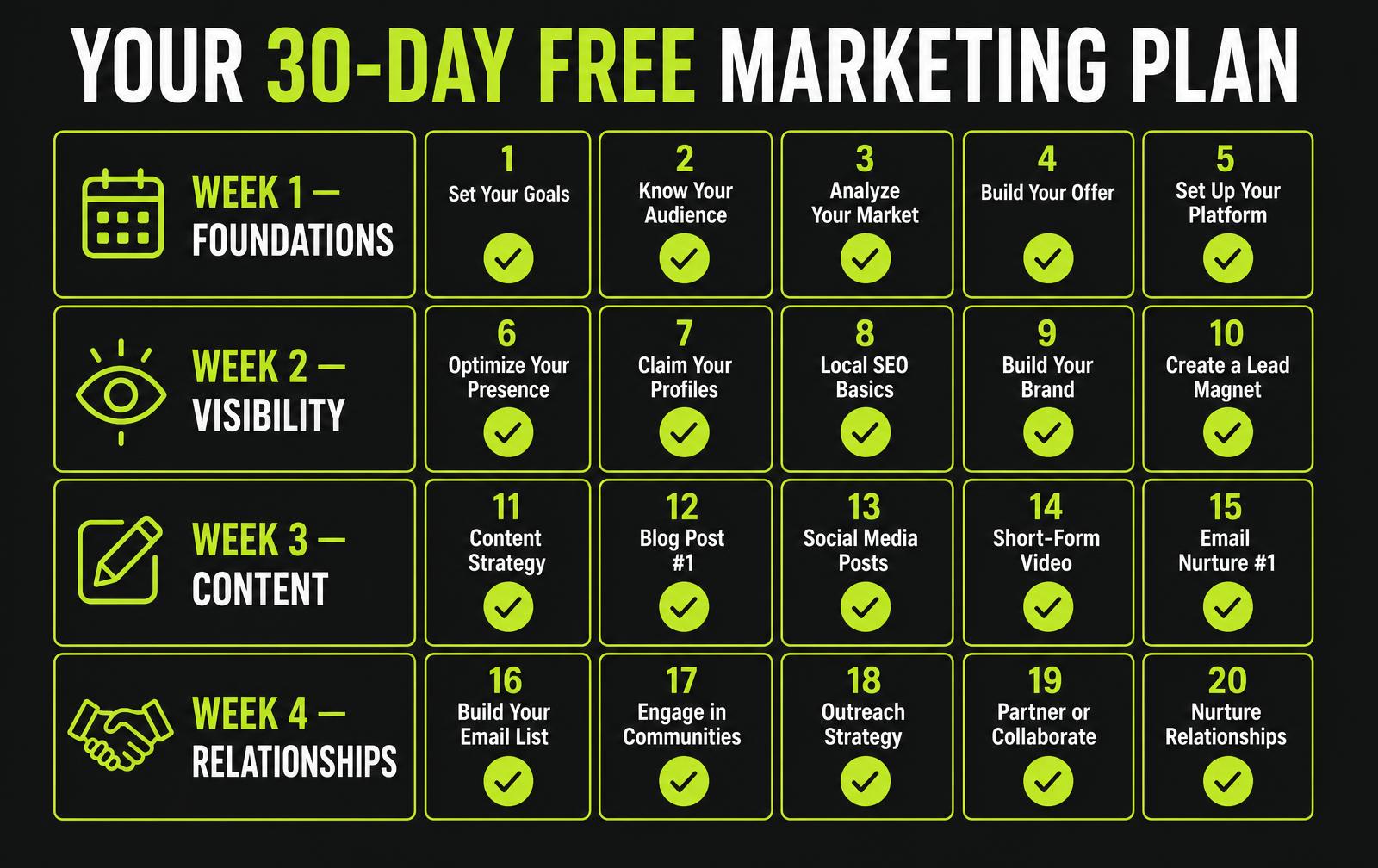
Your realistic 30-day marketing plan
This plan assumes you have a business to run. Most days take 15 to 30 minutes. If you miss a day, carry on from where you stopped rather than starting again.
Week 1 — Foundations
- Day 1: Search your own business name and see what a customer sees
- Day 2: Claim or review your Google Business Profile
- Day 3: Check your categories, hours, phone number and services
- Day 4: Add genuine photographs of real work
- Day 5: Read your homepage as a stranger would
- Day 6: Fix your main heading so it says what you do and where
- Day 7: Rest, or write down ten questions customers ask you
Week 2 — Visibility
- Day 8: Set up Google Search Console
- Day 9: Look at your Queries and write down one opportunity
- Day 10: Check GA4 is collecting data
- Day 11: Check your most important pages are indexed
- Day 12: Find your Google review link
- Day 13: Ask two happy customers for a review
- Day 14: List the areas your customers genuinely come from
Week 3 — Content
- Day 15: Choose the best customer question from your Week 1 list
- Day 16: Write the answer properly as an article or service page section
- Day 17: Publish it
- Day 18: Turn it into a social post
- Day 19: Turn it into a short video or a Google profile update
- Day 20: Add it to your website FAQs
- Day 21: Review which service pages are missing or too thin
Week 4 — Relationships
- Day 22: List five businesses serving the same customers without competing
- Day 23: Contact one of them
- Day 24: Follow up three old enquiries
- Day 25: Ask two past customers for a referral
- Day 26: Write one short case study of real work
- Day 27: Join two genuine local groups and read the rules
- Day 28: Answer one question in one of those groups
- Day 29: Fill in your monthly scorecard
- Day 30: Decide which three activities you will keep doing
10 marketing habits that waste small-business owners' time
- 1
Posting on every social platform
Choose where your customers actually are and do that properly.
- 2
Chasing followers instead of customers
Followers are not automatically revenue.
- 3
Buying fake followers
Avoid completely.
- 4
Buying fake reviews
Avoid completely. It breaches platform policies and destroys trust.
- 5
Posting only sales messages
Give people something useful before you ask for anything.
- 6
Joining groups purely to drop your link
Build recognition first.
- 7
Creating content with no connection to what you sell
Relevant traffic matters more than traffic.
- 8
Measuring success only by website visitors
Look at enquiries and revenue where you can.
- 9
Changing marketing strategy every week
Consistency beats novelty.
- 10
Trying all 30 methods simultaneously
Pick a few and do them properly.
More website visitors doesn't always mean more customers
Business A
5,000
monthly visitors
0
relevant enquiries
Business B
300
monthly visitors
15
relevant enquiries
Which website is performing better commercially?
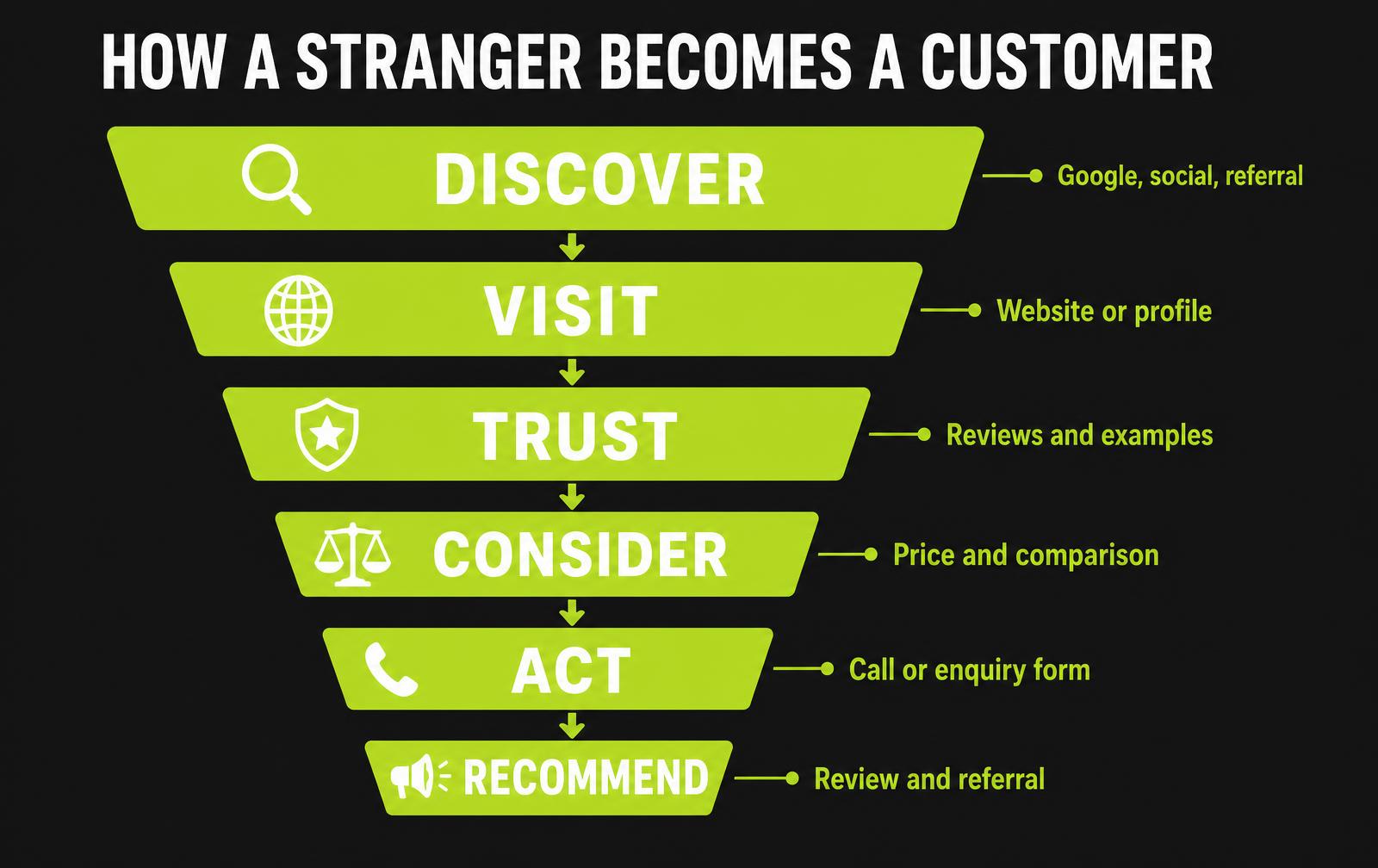
The goal is not simply more traffic. It is relevant visibility, then a useful visit, then trust, then action, then an enquiry or a customer. If you want to work on the middle of that chain, our guide on how to turn more website visitors into customers covers it properly.
How a stranger becomes a customer
Every free marketing method in this guide sits somewhere on this journey. If enquiries are not arriving, it is usually clear which stage is missing.
Free does not mean no cost
Everything in this guide is free of advertising spend. None of it is free of time, attention or consistency. Writing a good service page takes an afternoon. Filming useful videos every week takes discipline. Chasing reviews takes remembering to ask.
Sometimes paying for the right tool, or for professional help, is simply the more efficient route — particularly when your own hours are worth more spent doing the work you charge for. That does not undermine the point of this article. The sensible order is: start with free methods, measure what works, then invest where there is evidence of a return.
How do you know whether any of this is working?
You do not need a dashboard. You need eight honest answers each month.
- Enquiries
- How many new enquiries did you receive this month?
- Source
- Ask every new enquiry: how did you hear about us?
- Search Console
- Are relevant Google clicks and impressions increasing?
- Google Analytics
- Are relevant visitors increasing, and what do they do?
- Google Business Profile
- Are customers calling, requesting directions or clicking through?
- Reviews
- Is review volume and quality building naturally over time?
- Referrals
- How many new customers came from a recommendation?
- Sales
- Which activity ultimately led to paying work?
The rule
Do not continue something forever simply because it produces likes. Continue what produces useful visibility, conversations, leads, customers or valuable relationships.
Your simple monthly marketing scorecard
Print this, or copy it into a notebook. Fill it in on the last day of each month. No login, no spreadsheet, no software.
| Marketing activity | Time spent | Enquiries | Customers | Continue? |
|---|---|---|---|---|
| Social | ||||
| Referrals | ||||
| Partnerships | ||||
| Content | ||||
| Networking |
What should you do today?
If everything above feels overwhelming, do these five things:
- 1Check Google knows your business exists.
- 2Ask one happy customer for a genuine review.
- 3Make sure your homepage clearly says what you do.
- 4Follow up one previous enquiry.
- 5Answer one question a customer regularly asks.
Do those first. Come back tomorrow for the next five.
You don't need a huge marketing budget — you need a repeatable system
Small-business marketing becomes much easier when you stop trying random tactics and concentrate on a few channels that genuinely reach your customers.
You don't need to:
- post every day
- use every social network
- spend thousands on advertising
- become an SEO expert
- complete all 30 ideas this week
You do need to understand three things: where do my customers look, what do they need in order to trust me, and what makes them contact me?
Choose three or four methods from this guide. Do them properly. Measure what happens. Keep the activities that produce useful results, improve them, and only add another channel when you have the capacity to manage it well.
Getting people to find your business is only half the job
Once somebody discovers your business, your website needs to give them a reason to trust you and get in touch. Gee Web Design builds affordable, mobile-first websites for small businesses across the UK, with strong SEO foundations and clear routes from visitor to enquiry.
Frequently asked questions
Related guides
Keyword research for small businesses
Find the words your customers actually type.
Local SEO checklist for UK businesses
A practical checklist for local visibility.
Google Business Profile optimisation
Get every field of your profile right.
How to get more customers from your website
Turn the visitors you already have into enquiries.
Google Search Console for beginners
See which searches show your website.
Google Analytics for beginners
Understand what visitors do once they arrive.
Sources and official guidance
Nothing in this guide is legal advice. Where rules apply — Google's own policies, and UK direct-marketing rules — check the official pages, because they are the authority and they change.
- Google Business Profile Help — guidelines for representing your business
- Google Business Profile Help — business eligibility and ownership guidelines
- Google Business Profile Help — create a link or QR code to request reviews
- Google Business Profile Help — prohibited and restricted content
- ICO — direct marketing and PECR
- ICO — how do we comply with the PECR electronic mail marketing rules?
- ICO — business-to-business marketing